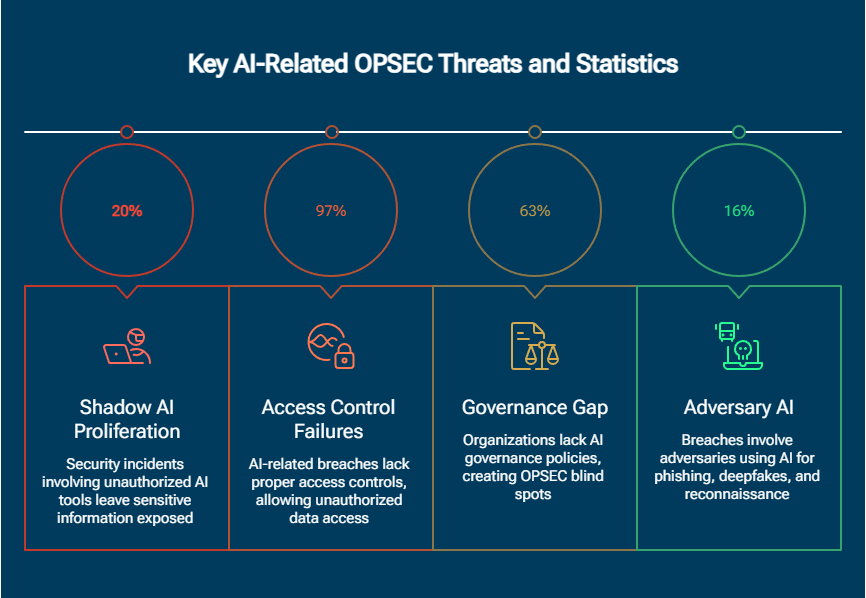
13 % aller Datenpannen betreffen mittlerweile KI-Modelle, -Anwendungen oder -Infrastruktur – wobei bei 97 % dieser Vorfälle keine angemessenen Zugriffskontrollen vorhanden waren ( Data Breach „Cost of a Data Breach 2025)
Auf Shadow-AI-Konten entfallen 20 % aller Sicherheitsvorfälle, und sie verursachen zusätzlich zu den Grundkosten durchschnittlich 670.000 US-Dollar an Kosten für Datenschutzverletzungen (IBM Data Breach „Cost of a Data Breach 2025)
63 % der Unternehmen verfügen entweder über keine Richtlinien zur KI-Governance oder sind noch dabei, diese zu entwickeln, während sie bereits aktiv KI-Funktionen einsetzen ( Data Breach „Cost of a Data Breach 2025)
CMMC 2.0 (in Kraft seit dem 10. November 2025) schreibt umfassende OPSEC-Programme für alle Auftragnehmer der Bundesregierung vor und verlangt die Einhaltung der Norm NIST SP 800-171 Rev. 2 (CMMC-Musterdokumentation, US-Verteidigungsministerium)
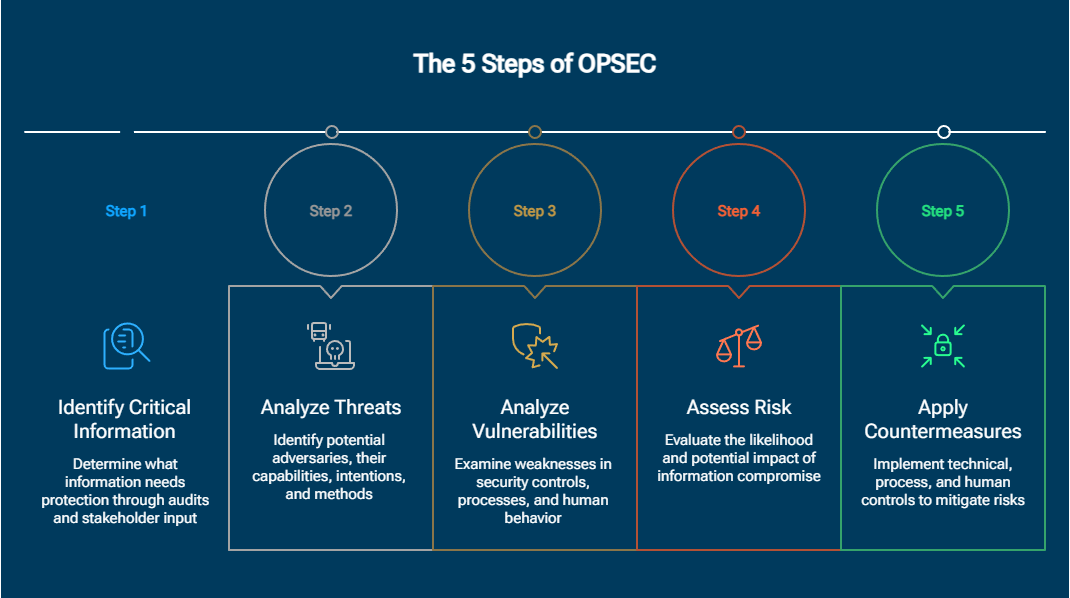
Operative Sicherheit (OPSEC) ist ein systematischer, fünfstufiger Prozess, der sensible Informationen schützt, indem er Abläufe aus der Perspektive eines Angreifers analysiert. Dabei wird ermittelt, welche Daten geschützt werden müssen, potenzielle Bedrohungen und Schwachstellen bewertet und gezielte Gegenmaßnahmen ergriffen, bevor Angreifer die offengelegten Informationen ausnutzen können.
Was ist OPSEC (Operations Security)?
OPSEC (Operations Security) ist ein systematischer Prozess, der darauf abzielt, kritische Informationen zu identifizieren, zu analysieren und zu schützen, die Gegner ausnutzen könnten, um den Betrieb, das Personal oder die strategischen Ziele einer Organisation zu schädigen. Dabei werden eigene Aktivitäten aus der Perspektive eines Gegners betrachtet und Vorgänge so analysiert, wie es ein Angreifer tun würde, um Schwachstellen zu erkennen und Gegenmaßnahmen zu ergreifen, die Gegnern die Informationen vorenthalten, die sie zur Planung und Durchführung von Angriffen benötigen.
Der Prozess hat seinen Ursprung im Vietnamkrieg, als das US-Militär 1966 das „Purple Dragon“-Team gründete, um zu untersuchen, warum feindliche Streitkräfte amerikanische Operationen immer wieder vorhersagen konnten. Das Team stellte fest, dass scheinbar harmlose Informationen, wenn sie zusammengefasst wurden, operative Muster offenbarten, die Gegner ausnutzen konnten, ohne Zugang zu geheimen Daten zu benötigen. Dies führte zur fünfstufigen OPSEC-Methodik, die bis heute die Grundlage der modernen Praxis der operativen Sicherheit bildet.
Moderne OPSEC umfasst den Schutz aller Informationen, die Gegnern operative Vorteile verschaffen könnten: technische Konfigurationen, Geschäftsprozesse, Personalinformationen und strategische Pläne, die zusammen die Angriffsfläche einer Organisation bilden.
Warum OPSEC für die Unternehmenssicherheit wichtig ist
Die Kosten von Verstößen gegen die Einsatzsicherheit sind messbar und steigen:
Durchschnittliche Kosten einer Datenpanne weltweit: 4,44 Millionen US-Dollar (2025); US-Unternehmen: 10,22 Millionen US-Dollar pro Vorfall
Unternehmen mit ausgereiften OPSEC-Programmen verzeichnen 71 % weniger Sicherheitsvorfälle
KI-gestützte Sicherheitsmaßnahmen verkürzen die Dauer von Sicherheitsverletzungen um bis zu 80 Tage
Phishing 16 % aller Sicherheitsverletzungen aus, wobei die durchschnittlichen Kosten pro Vorfall bei 4,80 Millionen Dollar liegen
Im Gegensatz zu reaktiven Sicherheitsmaßnahmen, die auf bereits stattfindende Angriffe reagieren, beugt OPSECSicherheitshacker und Angreifern, die Informationen zu sammeln, die für gezielte Angriffe erforderlich sind. Unternehmen mit ausgereiften OPSEC-Programmen berichten neben direkten Kosteneinsparungen auch von einer verbesserten Einhaltung gesetzlicher Vorschriften, niedrigeren Versicherungsprämien und einem gesteigerten Kundenvertrauen.
Das Aufkommen von „Shadow AI“ hat eine neue Kategorie von OPSEC-Schwachstellen mit sich gebracht, auf die im folgenden Abschnitt über OPSEC-Herausforderungen im Zusammenhang mit KI ausführlich eingegangen wird.
Operative Sicherheit im Unternehmenskontext: Obwohl OPSEC ursprünglich aus der Militärdoktrin stammt, hat sich die operative Sicherheit zu einer Kernkompetenz für Sicherheitsteams in Unternehmen entwickelt, die den Schutz von Geschäftsprozessen, M&A-Aktivitäten, Lieferkettenbeziehungen und cloud vor feindlicher Aufklärung umfasst.
Die 5 Schritte der OPSEC
Der fünfstufige OPSEC-Prozess bietet einen systematischen Rahmen zum Schutz kritischer Informationen vor Missbrauch durch Angreifer. Diese bewährte Methodik schafft einen wiederholbaren Prozess, den Organisationen an ihre spezifischen Bedrohungslagen und betrieblichen Anforderungen anpassen können.
Schritt 1 - Ermitteln kritischer Informationen
Unternehmen müssen durch umfassende Prüfungen ihrer Daten, Systeme und Abläufe ermitteln, welche Informationen geschützt werden müssen. Zu den kritischen Informationen zählen nicht nur offensichtliche Ziele wie geistiges Eigentum und Finanzdaten, sondern auch Fusionspläne, Infrastrukturkonfigurationen, Mitarbeiterverzeichnisse und strategische Initiativen, die Angreifer ausnutzen könnten.
Eine wirksame Identifizierung erfordert die Mitwirkung von Akteuren aus dem gesamten Unternehmen, da sich kritische Informationen je nach Abteilung und Funktion unterscheiden. Sicherheitsteams sollten mit den Geschäftsbereichen zusammenarbeiten, um Informationsressourcen zu erfassen, Vertraulichkeitsstufen zu klassifizieren und deren betriebliche Bedeutung zu erfassen. Dabei ist darauf zu achten, dass eine umfassende Abdeckung gewährleistet ist, ohne dass es zu einer übermäßigen Klassifizierung kommt, die die Schutzmaßnahmen verwässert.
Moderne Unternehmen müssen auch digitale Spuren berücksichtigen, die indirekt wichtige Informationen preisgeben: API-Endpunkte, DNS-Einträge, Zertifikat-Transparenz-Protokolle und cloud Buckets, die Einblicke in Organisationsstrukturen und Technologien gewähren und gezielte Angriffe erleichtern.
Schritt 2 - Analysieren Sie die Bedrohungen
Die Bedrohungsanalyse identifiziert potenzielle Angreifer, ihre Fähigkeiten, Absichten und Vorgehensweisen. Das Verständnis dafür, wie Angreifer die Cyber-Kill-Chain durchlaufen – von der anfänglichen Informationsbeschaffung über die Ausnutzung bis hin zur Exfiltration –, hilft Sicherheitsteams dabei, zu bestimmen, welche Informationsressourcen in jeder Phase den strengsten OPSEC-Schutz erfordern.
Jeder Angreifer wendet unterschiedliche Taktiken, Techniken und Vorgehensweisen (TTPs) an. Staatlich geförderte Akteure verfügen über Fähigkeiten im Bereich „Advanced Persistent Threats“ (APT) und zero-day , während Cyberkriminelle auf ransomware und Social Engineering zurückgreifen. Bedrohungen durch Wettbewerber konzentrieren sich auf den Diebstahl geistigen Eigentums und die Beschaffung strategischer Informationen sowohl durch technische als auch durch menschliche Aufklärungsmethoden.
Schritt 3 - Analyse der Schwachstellen
Bei einer Schwachstellenanalyse wird untersucht, wie Angreifer über Schwachstellen in Sicherheitskontrollen, Prozessen oder im menschlichen Verhalten an kritische Informationen gelangen könnten. Dabei wird aus der Perspektive eines Angreifers gedacht, um ausnutzbare Lücken zu identifizieren, die bei herkömmlichen Sicherheitsbewertungen übersehen werden.
Zu den häufigsten Schwachstellen zählen das Überteilen von Informationen in sozialen Medien, vorhersehbare Betriebsmuster, die Zeitpunkte und Standorte offenlegen, ungesicherte Kommunikationskanäle sowie unzureichende Zugriffskontrollen. Beziehungen innerhalb der Lieferkette bergen zusätzliche Risiken, wenn Partner keine gleichwertigen Sicherheitsstandards einhalten. Cloud bringen Lücken bei der geteilten Verantwortung, Risiken durch Mandantenfähigkeit und API-Sicherheitslücken mit sich, die neben herkömmlichen Kontrollmaßnahmen eine explizite OPSEC-Bewertung erfordern.
Schritt 4 - Risikobewertung
Bei der Risikobewertung werden die Wahrscheinlichkeit und die potenziellen Auswirkungen einer Kompromittierung kritischer Informationen durch die Kombination von Bedrohungs- und Schwachstellenanalysen ermittelt, wobei die Schutzmaßnahmen entsprechend der geschäftlichen Bedeutung, den gesetzlichen Anforderungen und den verfügbaren Ressourcen priorisiert werden.
Quantitative Methoden weisen Wahrscheinlichkeiten und Auswirkungen numerische Werte zu und ermöglichen so datengestützte Investitionsentscheidungen hinsichtlich Gegenmaßnahmen. Qualitative Bewertungen liefern ein kontextuelles Verständnis von Risiken, die sich einer Quantifizierung entziehen, wie Reputationsschäden, Wettbewerbsnachteile oder Kettenreaktionen, bei denen eine Sicherheitslücke weitere Angriffe ermöglicht.
Schritt 5 - Anwendung von Gegenmaßnahmen
Gegenmaßnahmen beseitigen oder verringern Schwachstellen durch technische Kontrollmaßnahmen, Prozessverbesserungen und Sensibilisierungsschulungen und schaffen so ein Gleichgewicht zwischen Sicherheit und betrieblicher Effizienz.
Zu den technischen Gegenmaßnahmen zählen Verschlüsselung, Zugriffsbeschränkungen, Netzwerksegmentierung und die Überwachung auf ungewöhnliches Verhalten. Prozessbezogene Gegenmaßnahmen umfassen die Festlegung von Richtlinien zum Informationszugang nach dem Need-to-know-Prinzip, Verfahren zum Umgang mit Informationen sowie Protokolle zur Reaktion auf Vorfälle. Personbezogene Gegenmaßnahmen konzentrieren sich auf Schulungen zur Sensibilisierung für Sicherheitsfragen und die Schaffung einer sicherheitsbewussten Unternehmenskultur.
Unternehmen sollten Gegenmaßnahmen in kontrollierten Umgebungen testen, ihre Wirksamkeit messen und sie auf der Grundlage der in der Praxis erzielten Ergebnisse anpassen.
OPSEC vs. InfoSec: Den Unterschied verstehen
OPSEC konzentriert sich speziell auf den Schutz kritischer operativer Informationen vor missbräuchlicher Nutzung durch Angreifer. InfoSec setzt umfassende technische Kontrollmaßnahmen ein, um alle Informationssysteme und Daten zu sichern.
Der folgende Vergleich verdeutlicht, wie sich diese beiden Ansätze hinsichtlich Schwerpunkt, Methodik und Umfang unterscheiden.
Aspekt
OPSEC
InfoSec
Hauptunterschied
Schwerpunkt
Schutz spezifischer operativer Informationen vor Angreifern
Sicherstellung aller Informationssysteme und Daten
OPSEC zielt auf kritische Informationen; InfoSec schützt alles
Näherung
Analysiert Operationen aus der Perspektive des Gegners
Implementiert umfassende Sicherheitskontrollen
OPSEC denkt wie die Angreifer; InfoSec baut Verteidigungen auf
Umfang
Kritische Informationen und Indikatoren
Gesamte Informationsinfrastruktur
OPSEC ist selektiv, InfoSec ist umfassend
Methodik
Analyseprozess in fünf Schritten
Implementierung einer rahmenbasierten Kontrolle
OPSEC verwendet bedrohungsgesteuerte Analysen; InfoSec folgt Standards
Der entscheidende Unterschied liegt in der Perspektive: OPSEC ermittelt, welche Informationen geschützt werden müssen und wie Angreifer diese Schutzmaßnahmen umgehen könnten; InfoSec stellt die technischen Mittel zum Schutz dieser Informationen bereit. Unternehmen erreichen optimale Sicherheit, indem sie beide Disziplinen miteinander verbinden.
Was versteht man unter OPSEC-Haftung?
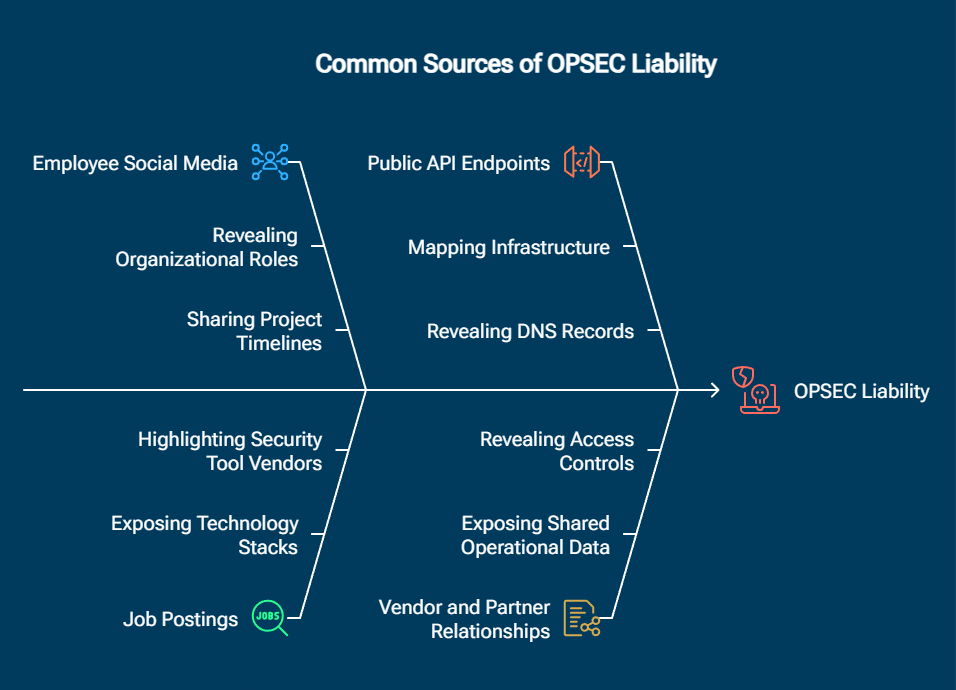
OPSEC-Risiken entstehen, wenn durch unkontrollierte Informationsweitergabe Gegner die erforderlichen Erkenntnisse erhalten, um gezielte Angriffe zu planen und durchzuführen. Im Gegensatz zu einer technischen Schwachstelle – also einem Fehler im System – entstehen OPSEC-Risiken dadurch, dass sich scheinbar harmlose Informationen zu verwertbaren Erkenntnissen summieren.
Einzelne öffentlich zugängliche Informationen sind für sich genommen harmlos. Eine Stellenanzeige gibt Aufschluss über den Technologie-Stack. Ein LinkedIn-Profil listet Projektverantwortlichkeiten auf. Eine Pressemitteilung kündigt eine strategische Partnerschaft an. Ein Konferenzvortrag beschreibt die interne Sicherheitsarchitektur. Zusammengenommen ergeben diese Informationen ein detailliertes Lagebild, das Angreifer nutzen, um hochwertige Ziele zu identifizieren, Organisationsstrukturen zu erfassen und Angriffe so zu timen, dass sie maximale Wirkung erzielen.
Angreifer, die Erkundungsmaßnahmen durchführen, nutzen Datenaggregation, um die Angriffsfläche einer Organisation aus öffentlich zugänglichen Quellen zu rekonstruieren, ohne auf ein einziges geschütztes System zugreifen zu müssen. Dabei kombinieren sie Stellenanzeigen, LinkedIn-Profile, Partnerankündigungen und DNS-Einträge zu einem detaillierten Informationsbild, das als Grundlage für gezielte Angriffe dient.
Häufige Ursachen für Verstöße gegen die OPSEC:
Aktivitäten von Mitarbeitern in sozialen Medien, die Einblicke in organisatorische Rollen, Standorte und Projektzeitpläne geben
Stellenanzeigen, die Einblicke in Technologie-Stacks, Anbieter von Sicherheitstools und operative Lücken geben
Öffentliche API-Endpunkte, DNS-Einträge und Zertifikatstransparenzprotokolle, die die Infrastruktur abbilden
Beziehungen zu Lieferanten und Partnern, bei denen gemeinsame Betriebsdaten und Zugriffskontrollen offengelegt werden
Konferenzvorträge, Pressemitteilungen und Telefonkonferenzen zur Bekanntgabe der Geschäftszahlen, die strategische Initiativen ankündigen
Um das OPSEC-Risiko zu verringern, sind regelmäßige OSINT-Prüfungen erforderlich, bei denen untersucht wird, welche Informationen Gegner aus öffentlichen Quellen zusammenstellen können, bevor ein Sicherheitsalarm ausgelöst wird.
OPSEC-Beispiele und Anwendungsfälle
Jüngste Vorfälle zeigen, wie Sicherheitslücken bei Kommunikationsplattformen, cloud und Beziehungen zu Drittanbietern zu einer Kettenreaktion von Sicherheitsverletzungen führen.
2025 OPSEC-Zeitplan für Vorfälle
Die folgende Zeitleiste gibt einen Überblick über tatsächliche OPSEC-Verstöße im Jahr 2025 und zeigt, wie sich die einzelnen Vorfälle ereignet haben, welche Ursachen sie hatten und welche praktischen Lehren Unternehmen daraus ziehen können, um ähnliche Sicherheitslücken zu vermeiden.
Schutz von Entwicklungsumgebungen als kritische Infrastruktur
Oktober 2025
Oracle EBS zero-day
Sicherheitslücke CVE-2025-61882
ransomware in mehreren Unternehmen
Schließen Sie kritische Schwachstellen sofort nach ihrer Aufdeckung.
Bewährte OPSEC-Praktiken
Für eine wirksame Umsetzung von OPSEC müssen technische Kontrollmaßnahmen, organisatorische Prozesse und menschliche Faktoren gleichzeitig berücksichtigt werden.
Führen Sie Zugriffskontrollen nach dem Prinzip der geringsten Berechtigungen ein, die auf Zero-Trust-Prinzipien basieren und jede Anfrage unabhängig von ihrer Quelle überprüfen, umseitliche Bewegung verhindert wird, falls Angreifer einzelne Konten kompromittieren. Regelmäßige Zugriffsprüfungen stellen sicher, dass die Berechtigungen den aktuellen Aufgabenbereichen entsprechen.
Führen Sie vierteljährliche OPSEC-Bewertungen anhand eines fünfstufigen Prozesses durch, um aufkommende Schwachstellen zu identifizieren und die Wirksamkeit von Gegenmaßnahmen zu überprüfen. Externe Red-Team-Übungen liefern die Perspektive eines Angreifers, die interne Teams aufgrund organisatorischer blinder Flecken übersehen.
Durch die Kompartimentierung wird der Zugriff auf Informationen eingeschränkt, indem sichergestellt wird, dass einzelne Personen nur auf die Daten zugreifen können, die für ihre spezifischen Aufgaben erforderlich sind. Spezielle Kommunikationskanäle und eingeschränkte Dokumentationsspeicher verhindern, dass einzelne Sicherheitsverletzungen den gesamten Betrieb gefährden.
Technische Überwachung, SIEM-Systeme, User and Entity Behavior Analytics (UEBA) sowieendpoint and Response (EDR)müssen anomales Verhalten erkennen, das auf Erkundungsaktivitäten hindeutet: ungewöhnliche Zugriffsmuster, Versuche der Datenaggregation und Privilegieneskalation. EDR erweitert die OPSEC-Kontrollen, indem es das Verhalten auf Geräteebene auf Anzeichen dafür überwacht, dass Angreifer auf der Grundlage gesammelter Informationen handeln, selbst wenn sie legitime Tools und gültige Anmeldedaten verwenden.
Checkliste für die OPSEC-Implementierung
Festlegung von Richtlinien zur Klassifizierung von Informationen, die Sensibilitätsstufen und Anforderungen an die Handhabung festlegen
Führen Sie eine Multi-Faktor-Authentifizierung für alle Systeme ein, die auf kritische Informationen zugreifen
Implementierung von Tools zur Verhinderung von Datenverlusten und zur Überwachung nicht autorisierter Informationsübertragungen
Erstellung von Schulungsprogrammen für Mitarbeiter zu Social Engineering, phishing und Social Media-Risiken
Entwicklung von Verfahren zur Reaktion auf Zwischenfälle, die speziell auf die Gefährdung von Informationen ausgerichtet sind
Überwachung von Dark-Web-Foren und Paste-Sites auf durchgesickerte Unternehmensinformationen
Durchführung regelmäßiger Schwachstellenbewertungen von öffentlich zugänglichen Anlagen und APIs
Einrichtung sicherer Kommunikationskanäle für die Erörterung sensibler Vorgänge
Implementierung von KI-Governance-Richtlinien mit klaren Genehmigungsverfahren für die Nutzung von KI-Tools
Prüfen Sie regelmäßig, ob KI-Schattenimplementierungen und nicht autorisierte KI-Dienste genutzt werden.
Einrichtung von Zugriffskontrollen für KI-Modelle, Anwendungen und Trainingsdaten
Überwachung der Sicherheit der KI-Lieferkette, einschließlich APIs, Plug-ins und Modelle von Drittanbietern
KI-bezogene OPSEC-Herausforderungen
Die rasante Verbreitung künstlicher Intelligenz hat neue Schwachstellen im Bereich der Betriebssicherheit (OPSEC) geschaffen. Data Breach „2025 Data Breach von IBM identifiziert KI und „Shadow-KI“ als aufkommende kritische Risiken: 13 % aller Datenlecks betreffen mittlerweile KI-Modelle, -Anwendungen oder -Infrastruktur – eine Kategorie, die in den vergangenen Jahren kaum existierte.
Ausbreitung der Schatten-KI
Wenn Mitarbeiter ohne Zustimmung des Arbeitgebers nicht genehmigte KI-Tools nutzen, schaffen sie unüberwachte Kanäle, über die sensible Informationen die Unternehmensgrenzen verlassen können. 20 % aller Sicherheitsvorfälle stehen im Zusammenhang mit „Shadow AI“, was die Kosten für Sicherheitsverletzungen um durchschnittlich 670.000 US-Dollar erhöht. Diese Einsätze umgehen Sicherheitskontrollen, unterliegen keiner Daten-Governance-Aufsicht und schaffen Prüfungslücken, die Angreifer ausnutzen. Mitarbeiter, die proprietären Code, Kundendaten oder strategische Pläne auf externe KI-Dienste hochladen, geben diese Informationen unbeabsichtigt an Dritte mit unbekannten Sicherheitsstandards weiter.
Fehler bei der AI-Zugangskontrolle
Bei 97 % der Sicherheitsverletzungen im Zusammenhang mit KI fehlen angemessene Zugriffskontrollen. Unternehmen, die KI-Modelle einsetzen, versäumen es, grundlegende Sicherheitsmaßnahmen, Authentifizierungsanforderungen, Autorisierungsprüfungen, Eingabevalidierung und Audit-Protokollierung zu implementieren. Dadurch entstehen Szenarien, in denen Angreifer KI-Systeme nach sensiblen Informationen abfragen, Ausgaben manipulieren oder Trainingsdaten unbemerkt abziehen können. Im Gegensatz zu herkömmlichen Anwendungen können KI-Modelle versehentlich sensible Trainingsdaten speichern und wiedergeben, auf feindliche Eingaben reagieren, die beabsichtigte Einschränkungen umgehen, und als Sammelstellen für Informationen aus verschiedenen Quellen dienen.
KI-Governance-Lücke
63 % der Unternehmen verfügen über keine Richtlinien zur KI-Governance oder befinden sich noch in der Entwicklungsphase, setzen jedoch bereits aktiv KI-Funktionen ein. Dies führt zu Schwachstellen in der Betriebssicherheit (OPSEC), da kritische Informationen ohne Aufsicht durch KI-Systeme fließen. Eine wirksame KI-Governance erfordert Richtlinien, die folgende Bereiche abdecken: die zulässige Nutzung genehmigter und nicht genehmigter KI-Tools, Anforderungen an die Datenklassifizierung für KI-Interaktionen, Genehmigungsverfahren für neue KI-Implementierungen, Überwachungs- und Prüfungsverfahren sowie Pläne zur Reaktion auf Vorfälle im Zusammenhang mit KI-bezogenen Sicherheitsverletzungen.
Einsatz von KI durch den Feind
Bei 16 % der Sicherheitsvorfälle setzten die Angreifer KI-Technologien ein, wobei 37 % KI-generierte phishing nutzten, umdie Übernahme von Konten und 35 % setzten Deepfakes zur Identitätsfälschung ein. Angreifer nutzen KI zur automatisierten Aufklärung aus öffentlichen Quellen, zur Generierung von Social-Engineering-Vorwänden und zum Ausführen vonSEO-Poisoning , die bösartige Download-Seiten über manipulierte Suchergebnisse anzeigen, sowie zur Anpassung von Angriffsstrategien in Echtzeit auf der Grundlage der Reaktionen der Verteidiger.
Wie Vectra AI Probleme im Bereich der operativen Sicherheit (OPSEC) im Zusammenhang mit KI Vectra AI
Vectra AI den OPSECVectra AI die „Attack Signal Intelligence™“ und erkennt Verhaltensmuster, die auf Aufklärungs- und Informationsbeschaffungsaktivitäten von Angreifern hindeuten, bevor diese eskalieren. Durch die gleichzeitige Analyse von Netzwerkverkehr, Identitätsverhalten und cloud deckt die Plattform OPSEC-Versäumnisse auf, die sich in ungewöhnlichen Zugriffsmustern, verdächtigen Datenbewegungen oder der Ausweitung von Zugriffsrechten äußern und tatsächlichen Angriffen vorausgehen. So wird OPSEC von einer präventiven Checkliste zu einer kontinuierlichen Erkennungsfunktion, die sich an die sich weiterentwickelnden Techniken der Angreifer anpasst.
Häufige OPSEC-Fehler und wie man sie vermeidet
Die vier häufigsten Muster für Verstöße gegen die Einsatzsicherheit im Jahr 2025:
Fehlerhafte Konfiguration der Kommunikationsplattform: Durch das Signalgate-Leck wurden die Identitäten von CIA-Mitarbeitern aufgrund eines einzigen falsch hinzugefügten Gruppenmitglieds offengelegt
Sicherheitslücken in der Entwicklungsumgebung: Bei dem Hackerangriff auf F5 Networks wurden Quellcode-Repositorys kompromittiert, denen produktionsrelevante Sicherheitskontrollen fehlten
Risiko durch Plattformen von Drittanbietern: Durch die Sicherheitsverletzung bei Qantas/Salesforce wurden 5,7 Millionen Datensätze aus 39 Unternehmen offengelegt, nachdem eine einzige gemeinsam genutzte Plattform kompromittiert worden war
Verspätete Installation von Patches: zero-day Oracle EBS war erfolgreich, weil die Unternehmen einen verfügbaren Patch nicht installiert hatten, bevor ransomware zuschlugen
Menschliches Versagen ist nach wie vor die größte Schwachstelle in der OPSEC. Die psychologische Dimension der OPSEC – also die Art und Weise, wie Angreifer vorhersehbare menschliche Verhaltensmuster ausnutzen – lässt sich allein mit technischen Mitteln am schwersten kontrollieren. Durch übermäßige Offenlegung in sozialen Medien werden Organisationsstrukturen, Projektzeitpläne und Technologie-Stacks preisgegeben, die Angreifer zu Aufklärungszwecken sammeln. Phishing sind erfolgreich, wenn Mitarbeiter sich der Social-Engineering-Techniken nicht bewusst sind oder sich unter Druck gesetzt fühlen, schnell zu reagieren.
Verhinderung von OPSEC-Fehlern
Regelmäßige Sicherheitsüberprüfungen sollten nicht nur die herkömmliche IT-Infrastruktur, sondern auch Kollaborationsplattformen, Entwicklungsumgebungen und Beziehungen zu Drittanbietern umfassen.Managed Detection and Response (MDR)-Dienste erhöhen die Wirksamkeit von OPSEC durch eine Überwachung rund um die Uhr, die erkennt, wenn Angreifer auf gesammelte Informationen reagieren – auch nachts, an Wochenenden und Feiertagen, wenn interne Teams am wenigsten verfügbar sind, um zu reagieren.
Organisationen, die ein wirksames OPSEC-Programm aufbauen, sollten den folgenden Kontrollmaßnahmen Priorität einräumen, da jede einzelne eine häufige Schwachstelle adressiert, an der Aufklärungsaktivitäten zu einer operativen Kompromittierung führen:
Zero-Trust-Zugriffsprüfungen für ausgeschiedene Mitarbeiter und bei Rollenwechseln
Lieferantenverträge, in denen OPSEC-Anforderungen mit Prüfungsrechten festgelegt sind
Sicherheitsprüfungen für Kollaborationsplattformen, die Konfigurationen für die mandantenübergreifende Freigabe abdecken
Automatisierte Überprüfung öffentlich zugänglicher Ressourcen vor jedem Bewertungszyklus
Quellen und Methodik
Dieser Leitfaden stützt sich auf Primärforschungsberichte, Regierungsdokumente und verifizierte Vorfallaufzeichnungen, die zum Stand des ersten Quartals 2026 aktuell sind. Alle statistischen Angaben verweisen auf ihre Primärquelle. Wenn Sekundärquellen auf Primärforschung verweisen, wird die Primärquelle direkt zitiert.
Data Breach zu den Kosten von Data Breach 2025 (ibm.com/reports/data-breach) – Quelle für Zahlen zu den Kosten von Datenschutzverletzungen, Statistiken zu KI-bezogenen Datenschutzverletzungen, Vorfallraten im Zusammenhang mit „Shadow AI“, Daten phishing sowie Angaben zur Verbreitung von KI bei Angreifern. IBM führt diese Untersuchung jährlich in Zusammenarbeit mit dem Ponemon Institute unter 604 Organisationen in 17 Branchen und 16 Ländern durch.
CMMC-Modelldokumentation – US-Verteidigungsministerium (dodcio.defense.gov/CMMC/Model) – Quelle für das Datum des Inkrafttretens von CMMC 2.0, die OPSEC-Anforderungen der Stufe 2 und die Zuordnung zu den Kontrollmaßnahmen gemäß NIST SP 800-171 Rev. 2.
MITRE ATT&CK (attack.mitre.org) – Quelle für Referenzen zu TTPs von Angreifern, die Zuordnung von Aufklärungstechniken (T1595 Aktives Scannen, T1598 Phishing Informationsbeschaffung) und die Klassifizierung des Verhaltens von Bedrohungsakteuren.
CISA-Notfallrichtlinie 26-01 (cisa.gov/emergency-directive-26-01) – Quelle für die Dokumentation von Sicherheitsverletzungen durch staatlich geförderte Akteure bei F5 Networks und die entsprechenden Abhilfemaßnahmen.
Nationales OPSEC-Programm – US-Amt des Direktors der Nationalen Nachrichtendienste (dni.gov/index.php/ncsc-what-we-do/ncsc-protect-your-secrets/national-opsec-program) – Quelle für die Ausrufung des Nationalen OPSEC-Bewusstseinsmonats und für die Standards des staatlichen OPSEC-Programms.
OPSEC steht für „Operations Security“ (Einsatzsicherheit) und bezeichnet einen systematischen Prozess, der darauf abzielt, kritische Informationen, die von Gegnern ausgenutzt werden könnten, zu identifizieren, zu analysieren und zu schützen. Obwohl der Begriff ursprünglich aus dem militärischen Nachrichtendienst stammt, findet OPSEC breite Anwendung in jeder Organisation, die sensible operative Informationen vor der Ausnutzung durch Gegner schützen muss.
Was ist das erste Gesetz der OPSEC?
Das erste Gesetz der OPSEC lautet: Wenn man die Bedrohung nicht kennt, wie soll man dann wissen, was man schützen muss? Dieser Grundsatz macht die Bedrohungsanalyse zur Grundlage aller OPSEC-Maßnahmen. Organisationen müssen konkrete Gegner identifizieren, deren Fähigkeiten und Ziele verstehen und einschätzen, welche Informationen für diese Gegner am wertvollsten wären, bevor sie Schutzmaßnahmen ergreifen.
Was versteht man unter OPSEC-Haftung?
Unter OPSEC-Risiko versteht man das kumulierte Risiko für eine Organisation, das entsteht, wenn die unkontrollierte Offenlegung von Informationen Angreifern Erkenntnisse liefert, mit denen sie gezielte Angriffe planen und durchführen können. Es entsteht durch die Zusammenführung von einzeln harmlosen Informationen wie Stellenanzeigen, sozialen Profilen von Mitarbeitern, Ankündigungen von Partnern und Daten zur öffentlichen Infrastruktur, die Angreifer zu verwertbaren Erkenntnissen kombinieren. Um das OPSEC-Risiko zu verringern, ist neben technischen Sicherheitsmaßnahmen eine kontinuierliche Bewertung der Risiken durch Open-Source-Informationen erforderlich.
Wie unterscheidet sich OPSEC von InfoSec?
OPSEC konzentriert sich darauf, kritische operative Informationen vor der Ausnutzung durch Angreifer zu schützen, indem operative Abläufe aus der Perspektive eines Angreifers analysiert werden. InfoSec setzt umfassende technische Kontrollmaßnahmen um, um alle Informationssysteme und Daten zu sichern. OPSEC ermittelt, welche Informationen geschützt werden müssen und wie Angreifer an diese gelangen könnten; InfoSec stellt die technischen Kontrollmaßnahmen bereit, um diese Informationen zu schützen.
Welche Branchen brauchen OPSEC am meisten?
Alle Organisationen profitieren von OPSEC, doch zu den Branchen mit dem höchsten Risiko zählen Rüstungsunternehmen und Regierungsbehörden, die geheime Informationen schützen, Finanzdienstleister, die Transaktionsdaten sichern, Einrichtungen des Gesundheitswesens, die Patientendaten schützen, Technologieunternehmen, die geistiges Eigentum schützen, sowie Betreiber kritischer Infrastrukturen, die Systeme schützen, die Ziel von Störmaßnahmen werden könnten.
Wie oft sollten OPSEC-Bewertungen durchgeführt werden?
Formelle OPSEC-Bewertungen sollten mindestens vierteljährlich unter Anwendung des fünfstufigen Verfahrens durchgeführt werden. Zusätzliche Bewertungen sollten nach wesentlichen operativen Änderungen, der Einführung neuer Technologien, organisatorischen Umstrukturierungen, Fusionen und Übernahmen oder Sicherheitsvorfällen erfolgen. Eine kontinuierliche Überwachung ergänzt die regelmäßigen Bewertungen, um einen Echtzeit-Überblick über neu auftretende Schwachstellen zu gewährleisten.
Was sind häufige OPSEC-Fehler?
Zu den häufigsten OPSEC-Fehlern zählen das Überteilen von Informationen in sozialen Medien und beruflichen Netzwerken, das Versäumnis, Risiken durch Dritte und in der Lieferkette zu bewerten, unzureichende Zugriffskontrollen, mangelhafte Mitarbeiterschulungen zum Thema Social Engineering, verspätete Patches für bekannte Sicherheitslücken, das Versäumnis, öffentlich zugängliche Ressourcen auf Informationslecks zu überwachen, sowie fehlende Richtlinien zur KI-Governance.
Gilt OPSEC auch für Telearbeiter?
Ja, für Remote-Mitarbeiter sind spezifische OPSEC-Maßnahmen erforderlich. Heimnetzwerke verfügen nicht über die Sicherheitskontrollen eines Unternehmens, was Schwachstellen bei der Kommunikation mit sensiblen Inhalten und beim Datenzugriff schafft. Remote-Mitarbeiter sollten VPNs und verschlüsselte Kommunikationsmittel nutzen, sensible Gespräche an öffentlichen Orten vermeiden und ihre Heimnetzwerke durch eine starke Authentifizierung sichern. Die OPSEC-Anforderungen gelten unabhängig vom Arbeitsort.