Schwachstellenanalyse erklärt: Der umfassende Leitfaden für Sicherheitsteams
Wichtige Erkenntnisse
Die Schwachstellenanalyse ist von grundlegender Bedeutung und keine Option. Angesichts eines jährlichen Anstiegs der CVE-Meldungen um 22 % und der Tatsache, dass 20 % aller Sicherheitsverletzungen auf die Ausnutzung von Schwachstellen zurückzuführen sind, ist eine systematische Schwachstellenanalyse eine grundlegende Sicherheitsanforderung.
Ein fünfstufiger Prozess verwandelt rohe Scandaten in umsetzbare Erkenntnisse. Planung, Erfassung, Scannen, Analyse und Berichterstellung bilden einen kontinuierlichen Kreislauf – kein einmaliges Projekt.
Die Häufigkeit muss sich nach dem Risiko richten, nicht nach dem Kalender. Kritische Ressourcen müssen wöchentlich oder kontinuierlich überprüft werden. Bei vierteljährlichen Überprüfungen entstehen Lücken von 45 bis 90 Tagen, während 28 % der Angriffe innerhalb von 24 Stunden nach Bekanntwerden erfolgen.
Die Compliance-Anforderungen nehmen zu. NIS2, DORA und PCI DSS v4.0 schreiben alle in festgelegten Abständen eine dokumentierte Schwachstellenanalyse vor, wobei die Strafen bis zu 10 Millionen Euro betragen können.
KI und kontinuierliche Überwachung schließen diese Lücke. Durch maschinelles Lernen gesteuerte Priorisierung reduziert Fehlalarme um 92–98 %, und das kontinuierliche Management der Bedrohungslage geht über herkömmliche CVE-Scans hinaus.
Schwachstellenanalyse: Kurzantwort
Eine Schwachstellenanalyse hilft Unternehmen dabei, Sicherheitslücken zu identifizieren und nach Priorität zu ordnen, bevor Angreifer diese ausnutzen können. Dabei werden bekannte Schwachstellen, Fehlkonfigurationen, veraltete Software, exponierte Dienste und andere Sicherheitslücken in Netzwerken, Anwendungen, Endgeräten, cloud und digitalen Ressourcen ermittelt.
Das Ziel besteht nicht lediglich darin, Schwachstellen aufzudecken, sondern zu erkennen, welche Schwachstellen das größte Risiko darstellen und daher zuerst behoben werden sollten. Moderne Schwachstellenanalysen kombinieren automatisierte Scans, die Erfassung von Systemressourcen, Bedrohungsinformationen und eine risikobasierte Priorisierung, um Sicherheitsteams dabei zu unterstützen, ihre Angriffsfläche zu verringern.
Wichtigste Erkenntnisse
Schwachstellenanalysen decken Sicherheitslücken auf, bevor Angreifer diese ausnutzen können.
Der Prozess hilft Unternehmen dabei, Abhilfemaßnahmen anhand von Risiko, Ausnutzbarkeit und geschäftlichen Auswirkungen zu priorisieren.
Die Schwachstellenanalyse ist ein Bestandteil eines umfassenderen Schwachstellenmanagementprogramms.
Moderne Bewertungen gehen über CVEs hinaus und umfassen auch cloud , Identitätsrisiken und Risiken im Zusammenhang mit der Angriffsfläche.
Da Unternehmen zunehmend auf cloud Hybridumgebungen umsteigen, ersetzt die kontinuierliche Überprüfung zunehmend die periodischen Scans.
Was ist eine Schwachstellenanalyse?
Die Schwachstellenanalyse ist ein systematischer Prozess zur Identifizierung, Klassifizierung und Priorisierung von Sicherheitslücken in den Systemen, Netzwerken und Anwendungen eines Unternehmens, bevor Angreifer diese diese ausnutzen.Das NIST definiert die Schwachstellenanalyse als „systematische Untersuchung eines Informationssystems oder Produkts, um die Angemessenheit von Sicherheitsmaßnahmen zu bestimmen, Sicherheitsmängel zu identifizieren, Daten zur Vorhersage der Wirksamkeit vorgeschlagener Sicherheitsmaßnahmen bereitzustellen und die Angemessenheit solcher Maßnahmen nach der Implementierung zu bestätigen.“
Praktisch gesehen bietet eine Sicherheitslückenanalyse Unternehmen eine strukturierte Methode, um eine einfache Frage zu beantworten: Wo bestehen bei uns Sicherheitsrisiken? Die Antwort darauf ist wichtiger denn je. Der Markt für Sicherheitslückenanalysen, dessen Wert im Jahr 2025 auf 5,58 Milliarden US-Dollar geschätzt wird, wächst mit einer durchschnittlichen jährlichen Wachstumsrate (CAGR) von 9,2 %, was die Dringlichkeit widerspiegelt, mit der Unternehmen Lücken in ihrer Transparenz schließen wollen.
Ein wichtiger Unterschied, den man frühzeitig verstehen sollte. Die Schwachstellenanalyse ist eine einmalige Maßnahme – eine Komponente innerhalb des umfassenderen Lebenszyklus des Schwachstellenmanagements. Bei der Analyse werden Schwachstellen identifiziert. Der Lebenszyklus des Schwachstellenmanagements umfasst die fortlaufende Überwachung, Behebung, Überprüfung und Steuerung über das gesamte Programm hinweg.
Schwachstellenanalyse im Vergleich zu verwandten Aktivitäten
Wenn man versteht, wo die Schwachstellenanalyse im Verhältnis zu Penetrationstests und Risikobewertung angesiedelt ist, lassen sich Unklarheiten hinsichtlich des Umfangs und eine falsche Zuweisung von Ressourcen vermeiden.
Aktivität
Zweck
Umfang
Ausgabe
Frequenz
Schwachstellenanalyse
Schwachstellen identifizieren und klassifizieren
Umfassend – alle betroffenen Vermögenswerte
Bericht über priorisierte Sicherheitslücken
Laufend bis vierteljährlich
Penetrationstests
Überprüfung der Ausnutzbarkeit bestimmter Schwachstellen
Eng gefasste – zielgerichtete Systeme
Ausbeutungssicher, Risikobeschreibung
Einmal jährlich bis zweimal jährlich
Risikobewertung
Die geschäftlichen Auswirkungen von Bedrohungen bewerten
Strategisch – Geschäftsprozesse
Risikoregister, Risikominderungsplan
Jährlich oder ereignisgesteuert
Schwachstellenmanagement
Ein fortlaufender Zyklus aus Erkennen, Beheben und Überprüfen
Unternehmensweit, kontinuierlich
Sanierungskennzahlen, Trenddaten
Fortlaufend
Tabelle: Vergleich der Schwachstellenanalyse mit verwandten Sicherheitsmaßnahmen.
Schwachstellenanalysen und Penetrationstests (VAPT) werden oft in einem Atemzug genannt, und das aus gutem Grund. Bei einer Schwachstellenanalyse werden Schwachstellen durch automatisierte Scans umfassend identifiziert, während bei Penetrationstests durch simulierte Angriffe überprüft wird, ob bestimmte Schwachstellen tatsächlich ausgenutzt werden können. Die Schwachstellenanalyse deckt ein breites Spektrum ab. Penetrationstests gehen hingegen in die Tiefe. Die meisten ausgereiften Programme nutzen beides – Schwachstellenanalysen für eine kontinuierliche Abdeckung und Penetrationstests für die regelmäßige Überprüfung kritischer Angriffspfade.
Eine Risikobewertung hingegen findet auf strategischer Ebene statt. Sie bewertet die geschäftlichen Auswirkungen identifizierter Bedrohungen und Schwachstellen im Kontext der Prioritäten, Ressourcen und Risikotoleranz der Organisation.
Der Prozess der Schwachstellenanalyse
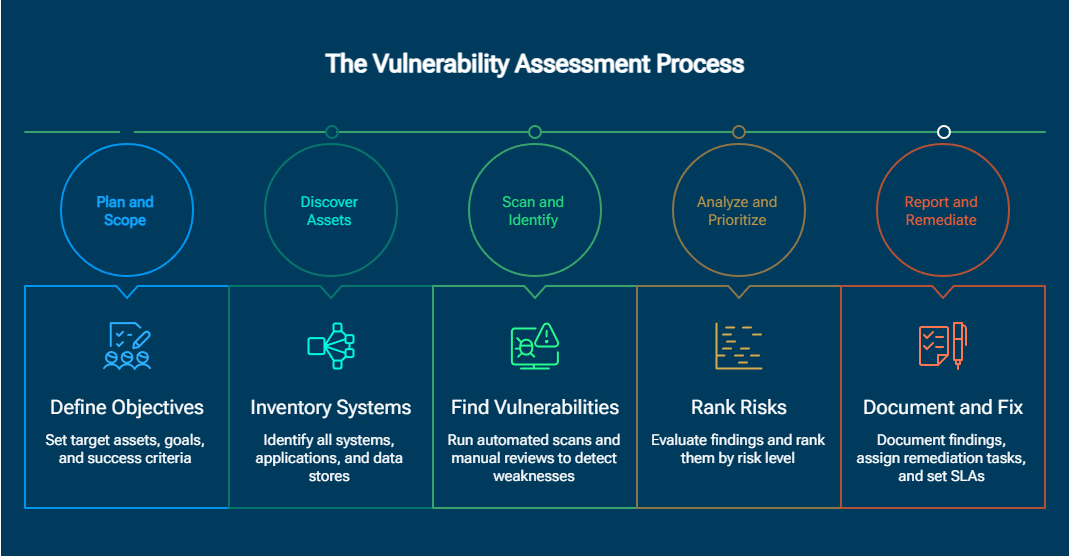
Ein fünfstufiger Prozess zur Schwachstellenanalyse wandelt Rohdaten aus dem Scan in umsetzbare Prioritäten für Abhilfemaßnahmen um. Jeder Schritt baut auf dem vorherigen auf, und der Zyklus wiederholt sich kontinuierlich.
Plan und Umfang – Festlegung der Zielobjekte, Ziele und Erfolgskriterien
Ressourcen erfassen – alle Systeme, Anwendungen und Datenspeicher inventarisieren
Scannen und identifizieren – automatisierte Scans und manuelle Konfigurationsüberprüfungen durchführen
Analysieren und priorisieren – Ergebnisse anhand verschiedener Faktoren nach Risikograd einstufen
Meldung und Behebung – Ergebnisse dokumentieren und Behebungsmaßnahmen mit SLAs zuweisen
Die Planung und Festlegung des Umfangs bildet die Grundlage. Die Teams legen fest, welche Ressourcen in den Umfang fallen – lokale Server, cloud , Container, IoT-Geräte – und definieren, wie Erfolg aussieht. Ohne eine klare Festlegung des Umfangs werden bei Bewertungen entweder kritische Systeme übersehen oder Zeit für irrelevante Ziele verschwendet.
Die Bestandserfassung erstellt ein vollständiges Inventar. Was man nicht kennt, kann man auch nicht bewerten. In diesem Schritt werden verwaltete und nicht verwaltete Geräte, Schatten-IT, cloud und Integrationen von Drittanbietern im gesamten modernen Netzwerk identifiziert. Unternehmen, die auf hybride Umgebungen umsteigen, entdecken häufig 15 bis 30 % mehr Ressourcen als in ihren CMDB-Einträgen verzeichnet sind.
Das Schwachstellenscanning kombiniert automatisierte Tools mit manuellen Konfigurationsprüfungen. Automatisierte Scanner überprüfen Systeme anhand bekannter CVE-Datenbanken, während bei der manuellen Überprüfung Logikfehler und Fehlkonfigurationen aufgedeckt werden, die den Scannern entgehen. Um die Ergebnisse korrekt interpretieren zu können, ist es unerlässlich, die Funktionsweise des Schwachstellenscannings zu verstehen.
Bei der Analyse und Priorisierung kommt es vor allem auf die Bewertungsmethodik an. Eine reine CVSS-Bewertung reicht nicht aus. Weniger als 1 % aller CVEs werden jemals für Angriffe genutzt, was einen rein auf CVSS basierenden Ansatz gefährlich ungenau macht. Eine effektive Priorisierung kombiniert CVSS-Basiswerte mit Daten aus dem Exploit Prediction Scoring System (EPSS), der Kritikalität der Assets, dem Kontext der Bedrohungsinformationen und den geschäftlichen Auswirkungen. Dieser multifaktorielle Ansatz stellt sicher, dass Teams zuerst das beheben, was wirklich wichtig ist – und nicht nur das, was auf dem Papier die höchste Punktzahl erzielt.
Durch Berichterstattung und Behebung wird der Kreislauf geschlossen. Ein Bericht zur Schwachstellenanalyse dokumentiert die Ergebnisse mit Risikoeinstufungen, betroffenen Systemen, Belegen und empfohlenen Abhilfemaßnahmen, wobei die Service Level Agreements (SLAs) an den Schweregrad gekoppelt sind. Kritische Schwachstellen erfordern unter Umständen eine Behebungsfrist von 72 Stunden. Für Ergebnisse mittlerer Schweregrad gelten möglicherweise 30-Tage-SLAs. Der Bericht fließt direkt in die Workflows zur Incident-Response ein, sobald eine aktive Ausnutzung festgestellt wird.
Die durchschnittliche Zeit bis zur Behebung einer Sicherheitslücke beträgt 32 Tage, doch 28 % der Exploits werden bereits innerhalb von 24 Stunden nach Bekanntwerden ausgenutzt. Diese Lücke zwischen Entdeckung und Behebung stellt die Herausforderung dar, der sich jedes Programm zur Schwachstellenanalyse stellen muss.
Arten von Schwachstellenanalysen
Sechs verschiedene Arten von Schwachstellenanalysen gewährleisten eine umfassende Abdeckung aller Ebenen der Angriffsfläche. Die Wahl der richtigen Art – oder Kombination – hängt von der Umgebung, dem Risikoprofil und den Compliance-Anforderungen ab.
Art der Bewertung
Zielbereich
Schlüsseltechniken
Wann zu verwenden
Netzwerk
Router, Switches, Firewalls, Hosts, Ports
Port-Scan, Dienstauflistung, Protokollanalyse
Mindestens vierteljährlich; nach Änderungen im Netzwerk
Webanwendung
Webanwendungen, APIs, Microservices
OWASP Top-10-Tests, DAST/SAST, API-Fuzzing
Vor der Bereitstellung; monatlich für Produktionsanwendungen
Agentenbasiertes Scannen, Validierung anhand von CIS-Benchmarks
Monatlich; nach den Patch-Zyklen
Datenbank
Datenbankserver, Schemata, Zugriffskontrollen
Prüfung von Zugriffsrechten, Überprüfung der Konfiguration, Überprüfung der Verschlüsselung
Vierteljährlich; nach Schemaänderungen
Cloud Container
Cloud , IaC-Vorlagen, Container-Images
Bildanalyse, IaC-Analyse, CSPM, Überprüfung der geteilten Verantwortung
Laufend; vor der Bereitstellung
Drahtlos
WLAN-Netzwerke, Zugangspunkte, Bluetooth
Erkennung von unberechtigten Zugangspunkten, Verschlüsselungsanalyse, Signalkartierung
Vierteljährlich; nach Änderungen an der Mobilfunkinfrastruktur
Tabelle: Sechs Arten der Schwachstellenanalyse und ihr Anwendungsbereich.
Bei Schwachstellenanalysen im Netzwerk wird die Netzwerksicherheitsinfrastruktur auf offene Ports, falsch konfigurierte Dienste und bekannte Schwachstellen in Netzwerkgeräten überprüft. Der Verizon DBIR 2025 ergab, dass 22 % der Sicherheitsverletzungen durch die Ausnutzung von Schwachstellen auf Edge-Geräte abzielten – was die Netzwerküberprüfung zu einer obersten Priorität macht.
Bei der Bewertung von Webanwendungen liegt der Schwerpunkt auf der Anwendungsschicht, wobei auf Injektionsschwachstellen, fehlerhafte Authentifizierung und Fehlkonfigurationen von APIs geprüft wird. Angesichts der zunehmenden Komplexität von Anwendungen und der durch CI/CD-Pipelines beschleunigten Bereitstellung muss die Bewertung von Anwendungsschwachstellen direkt in den Entwicklungslebenszyklus integriert werden.
Cloud Container-Bewertungen befassen sich mit den besonderen Herausforderungen der cloud – kurzlebige Workloads, Modelle der geteilten Verantwortung, Infrastructure-as-Code-Vorlagen und Schwachstellen in Container-Images. Herkömmliche Scan-Tools, die für statische Umgebungen entwickelt wurden, übersehen diese dynamischen Ressourcen vollständig.
Schwachstellenanalyse in der Praxis
Fallstudien aus der Praxis
Drei viel beachtete Vorfälle verdeutlichen, was passiert, wenn Programme zur Schwachstellenanalyse versagen.
Equifax (2017). Ein VA-Scan zielte auf das Stammverzeichnis ab, übersah jedoch ein Apache-Struts-Unterverzeichnis, das die Sicherheitslücke CVE-2017-5638 enthielt. Die Folge waren 147 Millionen offengelegte Datensätze und Gesamtkosten in Höhe von 1,38 Milliarden US-Dollar. Die Lehre daraus ist klar: Eine umfassende Bestandsaufnahme der Ressourcen und ein korrekter Scan-Umfang sind unabdingbar.
MOVEit (2023). Die CL0P-Angreifer nutzten eine zero-daySQL-Injection-Sicherheitslücke (CVE-2023-34362) in einem weit verbreiteten Dateiübertragungstool aus. Der Datenverstoß bei MOVEit betraf mehr als 2.700 Organisationen und 93,3 Millionen Personen. Die Lehre daraus ist, dass bei Software von Drittanbietern eine Bewertung der Offenlegung von Sicherheitslücken durch den Anbieter sowie eine Risikobewertung der Lieferkette erforderlich sind – nicht nur interne Scans.
Stryker (2026). Im März 2026 nutzten Angreifer Microsoft Intune MDM dazu, zwischen 80.000 und 200.000 Geräte bei einem großen Medizintechnikunternehmen zu löschen – ohne dabei malware einzusetzen. Es war keine CVE beteiligt. Die Lehre daraus ist, dass die Schwachstellenanalyse über das herkömmliche CVE-Scanning hinausgehen und auch Konfigurationen cloud , Identitätssicherheit sowie ransomwareähnliche Zerstörung durch legitime Admin-Tools.
Zusammengenommen zeigen diese Datenpannen, dass eine wirksame Bewertung einen umfassenden Umfang, die Berücksichtigung von Drittanbietern und eine Abdeckung erfordert, die über die CVE-Datenbank hinausgeht.
Kosten und ROI einer Schwachstellenanalyse
Die Kosten für Schwachstellenanalysen reichen von 1.000 US-Dollar für Scans kleinerer Umgebungen bis zu über 50.000 US-Dollar für unternehmensweite Projekte, je nach Umfang, Komplexität der Umgebung und danach, ob die Analyse intern oder durch einen Drittanbieter durchgeführt wird. Ein Leitfaden zur Preisgestaltung für Schwachstellenanalysen schlüsselt die typischen Kostenfaktoren nach Art der Analyse auf. Detailliertere Kostenvergleiche für Schwachstellenanalysen sind bei Branchenanalysten erhältlich.
Die Berechnung des ROI ist ganz einfach. Vergleichen Sie die Kosten für regelmäßige Schwachstellenanalysen mit den durchschnittlichen Kosten einer Sicherheitsverletzung – die von Jahr zu Jahr weiter steigen. Stellen Sie Schwachstellenanalysen in Gesprächen mit der Unternehmensleitung nicht als Kostenfaktor dar, sondern als Risikominderung mit messbarem Nutzen.
Wie oft sollte eine Beurteilung stattfinden?
Eine allgemeine Empfehlung, „vierteljährlich eine Bewertung durchzuführen“, reicht nicht aus. Die Häufigkeit der Bewertungen sollte der Kritikalität der Vermögenswerte, der Bedrohungslage und den Compliance-Vorgaben entsprechen.
Kritikalität der Anlagen
Gefahrenstufe
Compliance-Anforderung
Empfohlene Trittfrequenz
Kritisch (Kronjuwelen, öffentlich zugänglich)
Hoch (aktiv gezielt)
PCI DSS, HIPAA, NIS2
Wöchentlich oder fortlaufend
Wichtig (interne Anwendungen, Datenbanken)
Mittel (gängige Angriffsvektoren)
ISO 27001, CIS-Kontrollen
Monatlich
Standard (Arbeitsplätze, Dateiserver)
Gering (begrenzte Exposition)
SOC 2, interne Richtlinie
vierteljährlich
Niedrig (isoliert, unempfindlich)
Minimal
Keine besonderen Angaben
Halbjährlich
Tabelle: Matrix zur Häufigkeit der risikobasierten Schwachstellenanalyse.
Die Daten untermauern die Best Practices für eine hohe Scan-Häufigkeit. 28 Prozent aller Exploits erfolgen innerhalb von 24 Stunden nach Bekanntwerden einer Schwachstelle. Vierteljährliche Scans führen zu 45- bis 90-tägigen Sicherheitslücken – Zeitfenstern, in denen neu bekannt gewordene Schwachstellen ungepatcht und unentdeckt bleiben. PCI DSS v4.0 schreibt vierteljährliche Scans als Mindeststandard vor, während CIS Controls v8 wöchentliche Scans für kritische Ressourcen empfiehlt.
Aufbau eines effektiven Programms zur Schwachstellenanalyse
Erkennungsmethoden und bewährte Verfahren
Ein effektives Programm zur Schwachstellenanalyse schafft ein Gleichgewicht zwischen automatisierten und manuellen Ansätzen. Automatisierte Scans bieten Breite – sie überprüfen schnell Tausende von Systemen anhand bekannter Schwachstellendatenbanken. Manuelle Tests bieten Tiefe – sie decken Logikfehler, Schwachstellen in der Geschäftslogik und komplexe Fehlkonfigurationen auf, die automatisierten Tools entgehen.
Zu den bewährten Verfahren für den Aufbau eines ausgereiften Programms gehören:
Führen Sie ein aktuelles Bestandsverzeichnis Ihrer Ressourcen. Was Sie nicht kennen, können Sie auch nicht schützen. Berücksichtigen Sie dabei auch cloud, Container- und IoT-Ressourcen.
Integrieren Sie die automatisierte Validierung (VA) in CI/CD-Pipelines. Setzen Sie auf „Shift Left“, indem Sie Anwendungscode und Container-Images scannen, bevor die Bereitstellung in die Produktion gelangt.
Verfolgen Sie die Behebung von Problemen anhand von schwergradbasierten SLAs. Kritische Befunde erfordern eine Bearbeitungsfrist von 72 Stunden. Bei Befunden mit hohem Schweregrad sind sieben Tage vorgesehen. Bei mittlerem Schweregrad sind 30 Tage vorgesehen.
Integrieren Sie den CISA-KEV-Katalog für die Echtzeit-Überwachung. CISA fügt regelmäßig fünf bekannte, bereits ausgenutzte Sicherheitslücken hinzu – allein im März 2026 waren es mehr als elf Neuzugänge, was das Tempo der aktiven Ausnutzung verdeutlicht.
Vergleichen Sie die Ergebnisse mit den KPIs. Verfolgen Sie die durchschnittliche Zeit bis zur Behebung (Ziel: unter 32 Tagen, um den Branchendurchschnitt zu unterbieten), die Scan-Abdeckungsrate (Ziel: über 95 %) und die Falsch-Positiv-Rate (Ziel: unter 10 %).
Umgang mit Fehlalarmen
Falschpositive bei Schwachstellenanalysen gehören zu den hartnäckigsten operativen Herausforderungen. Falschpositive verschwenden die Zeit der Analysten, untergraben das Vertrauen in Scan-Tools und führen zu einer Alarmmüdigkeit, die dazu führt, dass Teams die Ergebnisse – einschließlich der echten – nicht mehr als vorrangig behandeln. Häufige Ursachen sind veraltete Signaturdatenbanken, Lücken im Umgebungskontext und falsch identifizierte Softwareversionen.
Strategien zur Reduzierung von durch maschinelles Lernen verursachten Fehlalarmen bei Schwachstellenscans erzielen mittlerweile Reduktionsraten von 92 bis 98 %, indem sie Scan-Ergebnisse mit dem Laufzeitkontext, Erreichbarkeitsanalysen und Exploit-Informationen korrelieren. Ein strukturierter Triage-Workflow – automatische Deduplizierung, kontextbezogene Anreicherung, manuelle Überprüfung der verbleibenden Hinweise und Weiterleitung bestätigter Befunde – sorgt dafür, dass sich die Analysten auf echte Bedrohungen konzentrieren können.
Branchenangaben zufolge werden nur 54 % der Sicherheitslücken vollständig behoben. Durch die Reduzierung von Fehlalarmen lässt sich dieser Wert direkt verbessern, da so sichergestellt wird, dass die Ressourcen für die Behebung auf echte Befunde konzentriert werden.
Übersicht über Tools und Automatisierung
Tools zur Schwachstellenanalyse lassen sich in vier Hauptkategorien einteilen. Netzwerkscanner identifizieren Schwachstellen in der Infrastruktur über Ports, Dienste und Konfigurationen hinweg. Webanwendungsscanner prüfen auf Schwachstellen der OWASP Top 10 sowie auf API-spezifische Schwachstellen. Container- und cloud befassen sich mit kurzlebigen Workloads und IaC-Vorlagen. Konfigurationsprüfprogramme validieren Systeme anhand von CIS-Benchmarks und Sicherheitsstandards.
Anstatt bestimmte Tools zu empfehlen, sollten Sie sich auf die Funktionen konzentrieren. Effektive Tools zur Erkennung und Bewertung von Bedrohungen sollten sowohl authentifizierte als auch nicht authentifizierte Scans ermöglichen, sich in Ticketing- und Orchestrierungsplattformen integrieren lassen, eine risikobasierte Priorisierung bieten, die über den reinen CVSS-Wert hinausgeht, und Berichte liefern, die auf die KPIs des Schwachstellenmanagementprogramms abgestimmt sind.
Schwachstellenanalyse und Compliance
Wichtige gesetzliche Rahmenbedingungen schreiben die Durchführung von Schwachstellenanalysen in festgelegten Abständen vor, weshalb die Erfassung der Compliance-Situation für jedes VA-Programm unerlässlich ist.
Der Übergang von periodischen zu kontinuierlichen Schwachstellenanalysen spiegelt einen grundlegenden Wandel in der Bedrohungsdynamik wider. Angesichts der Prognose von etwa 59.000 CVEs im Jahr 2026 können punktuelle Scans nicht mehr Schritt halten.
Die KI-gestützte Schwachstellenanalyse nutzt maschinelles Lernen für eine intelligente Priorisierung, die vorausschauende Planung von Behebungsmaßnahmen und eine automatisierte Triage. ML-Modelle korrelieren CVSS-Werte, EPSS-Wahrscheinlichkeiten, die Kritikalität von Assets und aktuelle Bedrohungsdaten, um jene 1–2 % der Schwachstellen aufzudecken, die tatsächlich sofortige Aufmerksamkeit erfordern. Allerdings sollte man Optimismus und Realismus in Einklang bringen. KI-Assistenten stehen hinsichtlich Geschwindigkeit und Genauigkeit in der Kritik – aktuelle KI-Tools zur Codeüberprüfung erreichen nur eine Rate von 56 % an sicherem Code, die Verarbeitung verläuft weiterhin langsam und es kommt nach wie vor zu Fehlalarmen.
Das Continuous Threat Exposure Management (CTEM) erweitert die Bewertung über CVEs hinaus auf Fehlkonfigurationen, das Durchsickern von Anmeldedaten, Schwachstellen in der Angriffsfläche und Identitätsrisiken. Der „WEF Global Cybersecurity Outlook 2026“ berichtet, dass 87 % der Befragten AI-bezogene Schwachstellen als die am schnellsten wachsende Risikokategorie identifizieren – was deutlich macht, dass herkömmliche CVE-Scans allein kritische blinde Flecken hinterlassen.
Die KI-spezifische Schwachstellenanalyse ist ein aufstrebendes Fachgebiet, das Modell-Scans, LLM-Red-Teaming, prompt injection und die Validierung der KI-Lieferkette umfasst. Da Unternehmen immer mehr KI-Systeme einsetzen, wird die Überprüfung dieser Modelle auf angreifbare Schwachstellen ebenso wichtig wie das Scannen herkömmlicher Infrastrukturen.
Wie Vectra AI die Schwachstellenanalyse Vectra AI
Vectra AI nach dem Prinzip, dass ein System bereits kompromittiert ist. Schwachstellenanalysen identifizieren Schwachstellen, bevor sie ausgenutzt werden – doch Angreifer werden unweigerlich Lücken finden, die bei solchen Analysen übersehen werden. Zero-day , Fehlkonfigurationen in cloud und identitätsbasierte Angriffe wie der Stryker-Vorfall von 2026 umgehen herkömmliche Schwachstellenanalysen vollständig. Hier kommt die kontinuierliche KI-basierte Bedrohungserkennung ins Spiel – nicht, um Schwachstellenanalysen zu ersetzen, sondern um das aufzuspüren, was diese nicht erfassen können. Wenn Angreifer ungepatchte Schwachstellen ausnutzen oder blinde Flecken der Identitätsbedrohungserkennung ausnutzen, erkennt Attack Signal Intelligence™ die Verhaltensweisen nach der Ausnutzung – laterale Bewegung, Privilegieneskalation, Datenvorbereitung –, die auf eine aktive Kompromittierung hinweisen. In Kombination mit Netzwerkdetektion und -reaktion entsteht so ein Modell der tiefgestuften Verteidigung, bei dem Schwachstellenanalysen das Risiko mindern und die Verhaltenserkennung das aufspürt, was durch die Maschen schlüpft.
Künftige Trends und neue Überlegungen
Die Landschaft der Schwachstellenanalysen entwickelt sich in vielerlei Hinsicht rasant weiter. In den nächsten 12 bis 24 Monaten sollten sich Unternehmen auf drei wesentliche Entwicklungen einstellen.
Agentenbasierte KI im Schwachstellenmanagement. KI-Agenten, die Schwachstellen selbstständig erkennen, validieren und sogar beheben, entwickeln sich vom Konzept hin zur ersten praktischen Anwendung. Diese Agenten vereinen das Scannen, die Priorisierung und die Erstellung von Tickets in automatisierten Arbeitsabläufen – wodurch sich das durchschnittliche Patch-Fenster von 32 Tagen potenziell verkürzen lässt. Die autonome Behebung bringt jedoch neue Risiken im Zusammenhang mit dem Änderungsmanagement und unbeabsichtigten Folgen mit sich, was eine sorgfältige Steuerung erfordert.
Erweiterte regulatorische Auflagen. Die verstärkte Durchsetzung der NIS2-Vorschriften in der gesamten EU ab 2026, die verschärften DORA-Anforderungen für den Finanzsektor sowie erwartete Aktualisierungen des NIST CSF werden den Compliance-Aufwand für Programme zur Schwachstellenanalyse erhöhen. Unternehmen müssen mit strengeren Vorgaben hinsichtlich Häufigkeit, Umfang und Dokumentation der Analysen rechnen – insbesondere in Sektoren mit kritischer Infrastruktur.
Konvergenz von Schwachstellenanalyse und Expositionsmanagement. Die Grenze zwischen Schwachstellenanalyse und dem umfassenderen Expositionsmanagement verschwimmt zunehmend. Das CTEM-Framework von Gartner prognostiziert, dass Unternehmen, die ein kontinuierliches Expositionsmanagement einführen, bis 2026 dreimal seltener Opfer einer Sicherheitsverletzung werden. Diese Konvergenz bedeutet, dass Schwachstellenanalyseprogramme über CVE-Datenbanken hinausgehen und Fehlkonfigurationen, Identitätsrisiken sowie Risiken cloud einbeziehen müssen – wie die Analyse des „Stryker Wiper“-Angriffs eindrucksvoll gezeigt hat.
Unternehmen sollten in den Aufbau von Funktionen zur mehrdimensionalen Priorisierung (CVSS + EPSS + Asset-Kontext + Threat Intelligence) investieren, den Umfang ihrer Bewertungen auf cloud Identitätsbereiche ausweiten und die Ergebnisse von Penetrationstests direkt in die Workflows zur Erkennung und Reaktion integrieren.
Schlussfolgerung
Die Schwachstellenanalyse gehört nach wie vor zu den grundlegendsten und wirkungsvollsten Maßnahmen, die ein Sicherheitsteam durchführen kann. Der Prozess ist einfach – Planung, Erfassung, Scan, Analyse, Berichterstattung –, doch für eine erfolgreiche Umsetzung sind ein umfassender Umfang, eine risikobasierte Priorisierung, eine angemessene Häufigkeit sowie die Integration in den gesamten Sicherheitsbetrieb erforderlich.
Die Bedrohungslage erfordert mehr als nur jährliche Routineprüfungen. Angesichts einer auf 59.000 ansteigenden Zahl von CVE-Einträgen im Jahr 2026, Ausnutzungsfenstern, die sich eher in Stunden als in Wochen bemessen lassen, und weltweit verschärften regulatorischen Auflagen benötigen Unternehmen Bewertungsprogramme, die kontinuierlich und kontextbezogen sind und mit Erkennungs- und Reaktionsabläufen verknüpft sind.
Beginnen Sie damit, Ihre derzeitige Abdeckung bei der Schwachstellenanalyse anhand des in diesem Leitfaden dargelegten Rahmens zu überprüfen. Ermitteln Sie die Lücken – werden cloud gescannt? Werden Identitätskonfigurationen abgedeckt? Werden Prioritäten nicht nur anhand des CVSS-Werts gesetzt? Bauen Sie darauf auf und entwickeln Sie ein Programm, das die Schwachstellenanalyse nicht als reine Compliance-Verpflichtung betrachtet, sondern als operative Disziplin, die Risiken mindert, bevor Angreifer sie ausnutzen können.
Eine Schwachstellenanalyse ist ein systematischer Prozess zur Identifizierung, Klassifizierung und Priorisierung von Sicherheitslücken in den Systemen, Netzwerken und Anwendungen eines Unternehmens. Das NIST definiert sie als „systematische Untersuchung eines Informationssystems oder Produkts zur Feststellung der Angemessenheit von Sicherheitsmaßnahmen“. In der Praxis nutzt eine Schwachstellenanalyse eine Kombination aus automatisierten Scan-Tools und manuellen Überprüfungen, um bekannte CVEs, Fehlkonfigurationen, fehlende Patches und unsichere Standardeinstellungen in der gesamten Umgebung aufzudecken. Der Prozess liefert einen nach Prioritäten geordneten Bericht, der die Ergebnisse den Risikostufen zuordnet, sodass Sicherheitsteams ihre Maßnahmen auf die Schwachstellen konzentrieren können, die am ehesten ausgenutzt werden. Angesichts von 48.185 im Jahr 2025 veröffentlichten CVEs und einer Prognose von etwa 59.000 für 2026 ist eine regelmäßige Bewertung nicht mehr optional – sie ist eine grundlegende Sicherheitsanforderung für jedes Unternehmen.
Was sind die vier Phasen einer Schwachstellenanalyse?
Das traditionelle vierstufige Modell umfasst die Identifizierung, Analyse, Risikobewertung und Behebung. Viele Unternehmen erweitern dieses Modell auf fünf Stufen, indem sie zu Beginn eine Planungs- und Umfangsfestlegungsphase hinzufügen. In der Identifizierungsphase werden Schwachstellen in den erfassten Systemen mithilfe automatisierter Scanner und manueller Verfahren aufgedeckt. Bei der Analyse werden die Ergebnisse klassifiziert und validiert, wobei echte Treffer von Fehlalarmen unterschieden werden. Die Risikobewertung stuft jede Schwachstelle anhand von Bewertungssystemen wie CVSS ein, kombiniert mit Daten zur Kritikalität der Ressourcen und zur Ausnutzbarkeit. Die Behebung setzt priorisierte Ergebnisse in Maßnahmen um – Patches, Konfigurationsänderungen, kompensierende Kontrollen oder Risikoakzeptanz. Der Prozess sollte kontinuierlich wiederholt werden, anstatt nach einem einzigen Durchlauf zu enden, wobei jeder Zyklus den Umfang verfeinert, die Erkennungsgenauigkeit verbessert und überprüft, ob frühere Behebungsmaßnahmen Bestand haben.
Was ist der Unterschied zwischen einer Schwachstellenanalyse und einem Penetrationstest?
Eine Schwachstellenanalyse identifiziert Schwachstellen umfassend durch automatisierte Scans und erstellt eine nach Priorität geordnete Liste bekannter Schwachstellen. Ein Penetrationstest überprüft, ob bestimmte Schwachstellen tatsächlich ausnutzbar sind, indem er reale Angriffstechniken gegen die Zielsysteme simuliert. Die Schwachstellenanalyse wirft ein weites Netz aus, um so viele Schwachstellen wie möglich zu finden. Penetrationstests gehen in die Tiefe, um die Ausnutzbarkeit nachzuweisen und die Auswirkungen auf das Geschäft aufzuzeigen. Die meisten Unternehmen benötigen beides. Schwachstellenanalysen werden häufig – monatlich oder kontinuierlich – durchgeführt, um eine umfassende Abdeckung zu gewährleisten. Penetrationstests werden jährlich oder halbjährlich an kritischen Systemen durchgeführt. Zusammen ergeben Schwachstellenanalysen und Penetrationstests (VAPT) ein vollständiges Bild sowohl der theoretischen Schwachstellen als auch der validierten Angriffspfade.
Wie oft sollten Schwachstellenanalysen durchgeführt werden?
Die Häufigkeit der Überprüfungen sollte sich nach der Kritikalität der Ressourcen, dem Bedrohungsgrad und den Compliance-Anforderungen richten – und nicht nach einem pauschalen Zeitplan. Kritische Ressourcen und öffentlich zugängliche Systeme erfordern wöchentliche oder kontinuierliche Überprüfungen. Interne Anwendungen und Datenbanken sollten monatlich überprüft werden. Standard-Arbeitsplätze und Systeme mit geringem Risiko können vierteljährlich überprüft werden. Die Daten stützen diesen risikobasierten Ansatz. Achtundzwanzig Prozent aller Exploits erfolgen innerhalb von 24 Stunden nach Bekanntwerden, was bedeutet, dass ein nur vierteljährliches Scannen zu 45- bis 90-tägigen Sicherheitslücken führt. PCI DSS v4.0 schreibt mindestens vierteljährliche Überprüfungen vor, CIS Controls v8 empfiehlt wöchentliche Scans für kritische Ressourcen, und NIS2 erwartet eine kontinuierliche Schwachstellenbehandlung für wesentliche Einrichtungen.
Wie viel kostet eine Schwachstellenanalyse?
Die Kosten reichen von 1.000 US-Dollar für kleine Scans einzelner Netzwerke bis zu über 50.000 US-Dollar für unternehmensweite Bewertungen, die mehrere Umgebungen, cloud und Anwendungsportfolios umfassen. Zu den wichtigsten Faktoren, die die Kosten beeinflussen, gehören der Umfang (Anzahl der IP-Adressen, Anwendungen und Umgebungen), die Art der Bewertung (Netzwerk, Anwendung oder umfassend), ob die Bewertung ausschließlich automatisiert erfolgt oder eine manuelle Validierung beinhaltet, sowie die Frage, ob sie intern oder von einem externen Dienstleister durchgeführt wird. Die relevantere Berechnung ist der ROI. Vergleichen Sie die jährlichen Kosten für regelmäßige Bewertungen mit den durchschnittlichen Kosten einer Datenpanne, den Bußgeldern für Nichteinhaltung gesetzlicher Vorschriften und den Betriebsunterbrechungen durch Vorfälle, die durch frühzeitige Erkennung hätten verhindert werden können.
Was ist der Unterschied zwischen einer Schwachstellenanalyse und dem Schwachstellenmanagement?
Die Schwachstellenanalyse ist eine punktuelle Maßnahme, bei der Sicherheitslücken identifiziert und priorisiert werden. Das Schwachstellenmanagement hingegen ist ein fortlaufender Prozess, der neben der Schwachstellenanalyse auch die Bestandsaufnahme von Systemressourcen, die Nachverfolgung von Korrekturmaßnahmen, die Überprüfung, die Behandlung von Ausnahmen sowie die kontinuierliche Programmsteuerung umfasst. Stellen Sie es sich so vor: Eine Bewertung ist eine Momentaufnahme. Das Schwachstellenmanagement ist der Film – die fortlaufende operative Disziplin, Schwachstellen über ihren gesamten Lebenszyklus hinweg zu finden, zu beheben, zu verifizieren und zu melden. Unternehmen benötigen beides – einzelne Bewertungen, um Probleme zu finden, und ein Managementprogramm, um sicherzustellen, dass diese behoben werden und dauerhaft behoben bleiben.
Was ist eine kontinuierliche Schwachstellenanalyse?
Die kontinuierliche Schwachstellenanalyse ersetzt regelmäßige punktuelle Scans durch eine permanente Überwachung, die neue Schwachstellen sofort nach ihrem Auftreten erkennt. Dieser Ansatz ergibt sich aus der Tatsache, dass täglich neue CVEs veröffentlicht werden und 28 % aller Exploits innerhalb von 24 Stunden nach ihrer Bekanntgabe genutzt werden – was vierteljährliche oder sogar monatliche Scans für kritische Ressourcen unzureichend macht. Die kontinuierliche Bewertung lässt sich in das Asset-Management, Threat-Intelligence-Feeds und den CISA-Katalog bekannter ausgenutzter Schwachstellen integrieren, um neue relevante Befunde automatisch zu kennzeichnen. Sie steht im Einklang mit dem umfassenderen Rahmenwerk für das kontinuierliche Management von Bedrohungsrisiken (CTEM), das über CVE-Scans hinausgeht und Fehlkonfigurationen, Identitätsrisiken sowie Risiken cloud einbezieht.